

The National Bowel Cancer Screening Test: What It Involves and What Happens Next
What the free at-home bowel screening test involves, who receives it, and what a positive or negative result means.
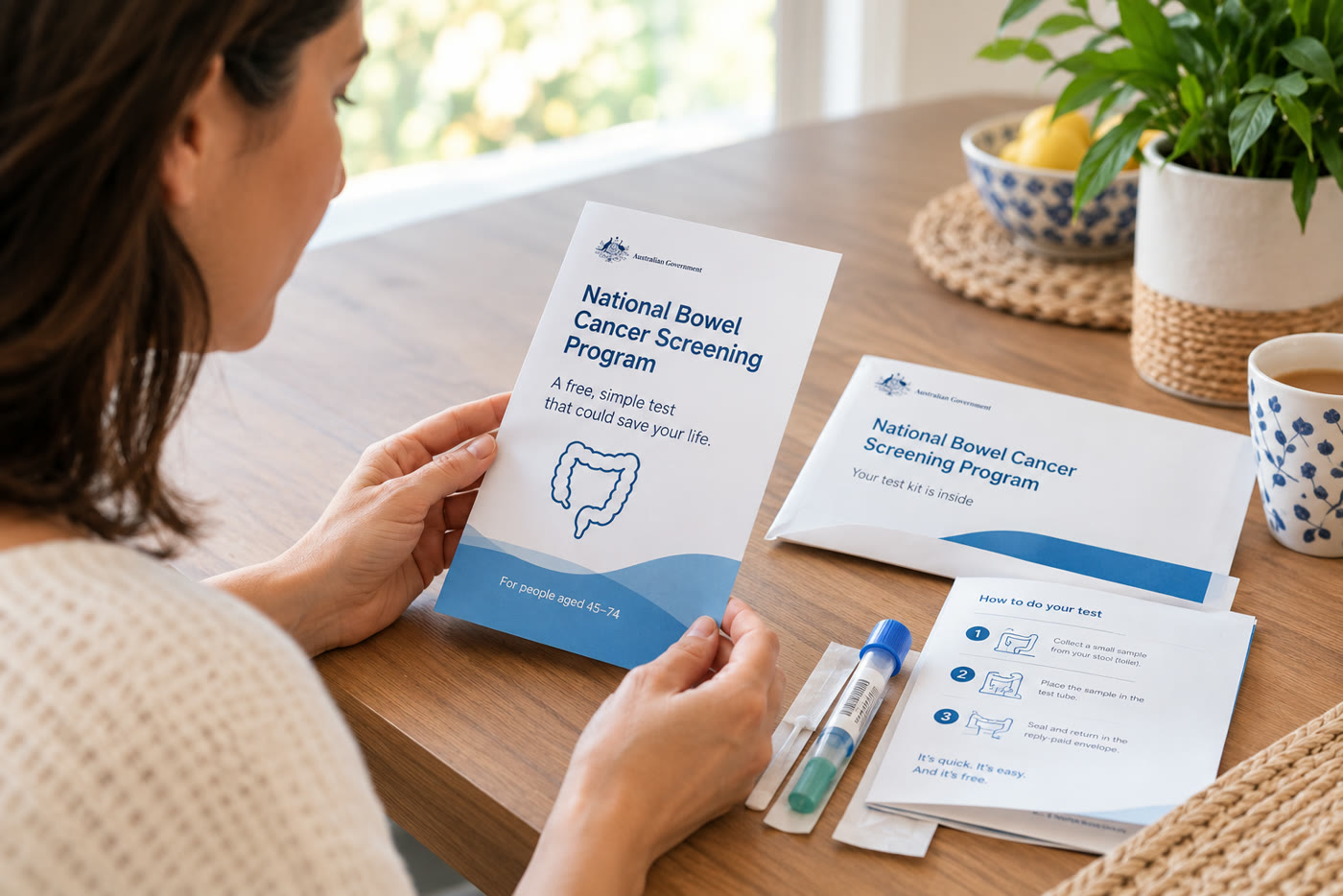
If a small envelope from the National Bowel Cancer Screening Program has turned up in your letterbox and is now sitting in a drawer somewhere, you’re far from alone. It’s one of the most avoided pieces of mail in Australian households: not because it’s difficult, but because it’s awkward, and awkward things get put off.
Here’s what it actually involves, because the reality is a lot less confronting than the anticipation.
Why does this test exist?
Bowel cancer often develops with no symptoms at all in its early stages. It can grow in the bowel for years before it causes any noticeable problem, and along the way it can release tiny amounts of blood into your stool: amounts far too small to see just by looking. That’s the entire premise of this test: it detects blood you’d never know was there.
Caught early, bowel cancer is genuinely one of the more treatable cancers: around 90% of cases found early can be successfully treated. Caught late, the outlook changes substantially. The test exists purely to shift more cases into that earlier, more treatable category.
Who gets it, and when?
If you’re aged 50 to 74, you’ll automatically be mailed a free test kit every two years, generally around the time of your birthday (though it can arrive up to six months later). If you’re aged 45 to 49, you’re now also eligible: you just need to actively request your first kit, either through the online form, by calling 1800 627 701, or by asking your GP.
What does the test actually involve?
This is the part that stops most people, so it’s worth being specific: you’re collecting two tiny samples from your own stool, at home, in private, using tools provided in the kit. That’s it. It happens across two separate toilet visits: not two different days necessarily, just two separate collections: and the whole process from opening the envelope to sealing it back up takes a few minutes each time.
You’re not sending anything unpleasant through the post in any visible way. The kit is specifically designed so the sample is sealed and unremarkable from the outside. People who’ve actually done it consistently describe it as quicker and less confronting than they expected going in.
What happens after you send it back?
You mail the completed kit back in the reply-paid envelope provided, and results typically arrive within about two weeks. Most results come back negative: meaning no blood was detected, and you’re done until your next kit in two years.
If the result is positive, that means blood was detected: not that you have bowel cancer. A positive result simply means further investigation is needed, almost always a colonoscopy, to work out where that blood came from. Plenty of things unrelated to cancer can cause a positive result. It’s a prompt to look closer, not a diagnosis.
What if I’ve missed one, or never done one at all?
There’s no penalty and no judgement here. If a previous kit expired unused, or you’ve never done one, you can request a replacement or a first kit at any time by contacting the National Cancer Screening Register or asking your GP. The two-year cycle simply resets from whenever you next complete a test: it isn’t derailed by having missed a round.
If it’s currently sitting in a drawer
If you’ve got a kit at home you haven’t gotten around to, leaving it somewhere visible on the bathroom bench rather than in a cupboard genuinely helps. It’s designed to take a few minutes across two toilet visits whenever suits you. There’s no appointment to book and no waiting room involved; the only step left is actually doing it.
If you have any questions about the test, your eligibility, or what a result might mean for you, your GP can talk it through: and if you’re overdue or have never received a kit, that’s an easy thing to sort out at your next appointment.